08th Oct 2026
Gloucestershire renews call for devolution deal with the South West
Despite the pause in local government reorganisation, leaders want a clear route to join the…


On Monday 7 September the government announced that Local Government Reorganisation (LGR) is being paused and reviewed. This includes the proposals for a new local authority structure here in Gloucestershire.
This is an unexpected announcement from the government, which we know will prompt many questions from all stakeholders across Gloucestershire.
The Secretary of State for Housing, Communities and Local Government has stated that the review follows updated legal advice provided to ministers.
The government has said that the purpose of the review is to ensure the reorganisation process is “robust, complies with legal requirements, and aligns with the priorities of the new administration and its wider plans for devolution and local government reform”.
As part of this announcement, the government also confirmed that local elections scheduled for May 2027 will proceed on existing council boundaries while the review is carried out.
At this stage, we do not have any further detail on the implications for Gloucestershire or on the timescales for completing the review.
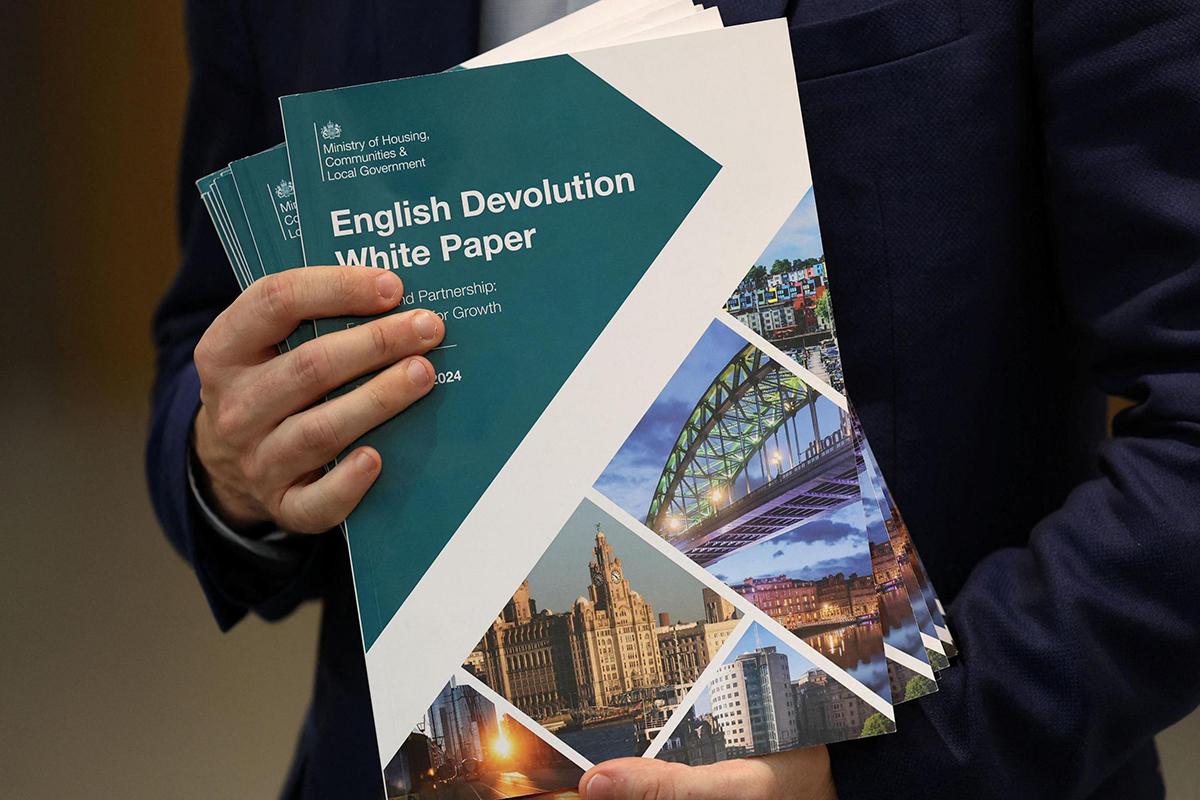
The current system of local government is complicated with different types of councils responsible for various aspects of our day-to-day lives.
These councils include strategic authorities (currently these are mayoral combined authorities such as Greater Manchester), county councils, city councils, borough councils, district councils and parish councils.
In Gloucestershire, we have:
The main goals of the White Paper are to give local areas more control over decisions (known as devolution) and to make the local government structure simpler (known as Local Government Reorganisation, or LGR).
The Government has today announced its decision on the future structure of local government in Gloucestershire.
The decision is to create a single unitary council, which will replace existing county, city, district and borough councils on 1 April 2028.
The Government has said that the single unitary option best met the criteria. This was particularly the case in three respects: it provides a sensible geography for economic growth and housing, it is easier to deliver joined up public services, and a good platform for community empowerment.
More detail on the rationale can be read in this letter from the Secretary of State, who made the announcement in the House of Commons on 16 July 2026.
At this stage, there will be no changes to council services which will be delivered as normal. Residents should continue to access these services in the way they normally would.
In recent months, our councils have been working very well together, preparing to deliver on the government’s decision. That work will continue while we get into the detail of the decision and exactly how it will be implemented, with full focus on ensuring the best outcomes for our local communities.
While our councils adopted their own position regarding the best future structure of local government in Gloucestershire, we are united in our commitment to the people and communities we serve. Our shared priority has always been to ensure that residents and businesses continue to receive the services they rely on, and that those services are delivered to the very highest standard.
We recognise that while this decision brings a degree of clarity about the future of local government in Gloucestershire, it will also raise further questions that we are not yet able to answer.
We are still at an early stage in this process. The new council needs to be created legally. Then there will be elections to a shadow authority on 6 May 2027 which will make the key decisions related to the creation of the new council. The new council will be effective from 1 April 2028.
Throughout this process, our seven councils remain committed to keeping residents, staff and partners fully informed and will share more information as it becomes available.
This is the quickest possible timetable for setting up a new council in Gloucestershire. The dates may change, depending on decisions made by the government.
Gloucestershire councils submit interim plan and proposal for new unitary structure.
Gloucestershire councils submit full proposal and plan for new unitary structure.
Government decision on new councils for Gloucestershire
Government pause and review.
All future milestones are subject to review.
Elections for new unitary (shadow authority).
New unitary structure introduced.
The Joint Scrutiny Panel is established to provide cross-council, non-executive and non-decision making scrutiny of the process for Local Government Reorganisation (LGR) across Gloucestershire, including the arrangements for governance, decision-making, finance, engagement, evidence and transparency.
Committee agendas, meetings and minutes are hosted on the Cheltenham Borough Council Democratic webpage.
The government has announced that Local Government Reorganisation (LGR) is being paused while it carries out a review. This includes the proposals affecting Gloucestershire.
At this stage, we do not have any further detail about what the review will mean for Gloucestershire or how long it will take. Gloucestershire’s councils are seeking further information from the Government and will provide an update as soon as more is known.
The government has said that the review follows updated legal advice provided to ministers. It says the review will ensure the reorganisation process is robust, complies with legal requirements and aligns with the new administration’s priorities for devolution and local government reform.
Yes. The government has confirmed that local elections scheduled for May 2027 will go ahead on existing council boundaries while its review of Local Government Reorganisation is carried out.
This is a decision taken by Government following consideration of proposals submitted locally. Those proposals were informed by evidence around service delivery, financial sustainability and local identity. Announcing its decision, the Government has said that the single unitary option best met the criteria. This was particularly the case in three respects: it provides a sensible geography for economic growth and housing, it is easier to deliver joined up public services, and a good platform for community empowerment.
There will be no immediate changes to council services, which will continue to be delivered as usual. All proposals submitted were supported by technical evidence on governance, service integration, financial resilience and economic growth. At this stage, detailed delivery planning is still underway, and further information will be published as it becomes available.
Local engagement and stakeholder feedback formed part of the evidence submitted to Government. It has committed to publish responses to a consultation held in February. We will share that document here when it is available.
Councils have worked collaboratively throughout the process, although there have been differing views on the preferred model. The priority now across all councils is to work together constructively in the interests of residents.
We will continue to facilitate appropriate interview opportunities with leaders and senior officers at key stages, particularly as more detail becomes available.
There will be no immediate changes to how residents receive services. Over the longer term, the aim is to simplify arrangements and improve coordination, but this will take time to design and implement.
There should be no immediate impact. A key objective of reorganisation is to maintain and, where possible, improve service quality and accessibility.
Funding arrangements are set nationally and will be considered as part of the implementation process. Ensuring fair and sustainable funding for all areas will be a key priority.
There will be upfront costs associated with reorganisation, as is the case with any structural change. These are typically funded through a combination of transitional support and local resources, with the expectation of longer-term efficiencies.
Estimated savings were included in the business cases submitted. However, precise figures will be refined during detailed implementation planning.
There will be no immediate changes to council tax. Future council tax decisions will be made by the new shadow council and will apply from 1st April 2028.
It is too early to confirm specific staffing implications. It is too early to confirm specific staffing implications but our aim is for the vast majority of staff to be TUPE’d into the new organisation, with any initial redundancies likely to be limited to the most senior positions.
These considerations will form part of the detailed design phase. No immediate changes are planned, and services will continue to operate as usual.
Maintaining strong local representation is a key priority. Arrangements such as local neighbourhood partnerships are likely to play an important role – neighbourhood partnerships will help make sure local communities are heard and involved in shaping services. This means services can better reflect the needs and priorities of the people who use them.
This will be determined as part of governance design, including ward structures and decision-making frameworks.
The Joint Scrutiny Panel is established to provide cross-council, non-executive and non-decision making scrutiny of the process for Local Government Reorganisation (LGR) across Gloucestershire, including the arrangements for governance, decision-making, finance, engagement, evidence and transparency.
Elected members will continue to be accountable to residents, as they are now. Shadow elections are due to take place in May 2027.
We will provide regular updates through Future Gloucestershire and council channels, media briefings, and public information resources including FAQs.
These include:
We will keep residents fully informed of each stage at the appropriate time.
A formal programme has been established, involving senior officers and elected members.
A shadow authority typically prepares the new organisation, including budgets and policies, ahead of vesting day. Existing councils continue delivering services during this period.
Elections are due to take place on May 6, 2027 for elections to the shadow authority. The shadow authority will make decisions which will inform the creation of the new council, which will be effective from 1 April 2028.
This follows the standard democratic electoral process, with candidates selected by political parties or standing independently.
Councils are experienced in working across political differences. The statutory framework for local government ensures decisions can continue to be made effectively.
The Government’s decision is final. However, the decision-making process can be challenged through a Judicial Review. A Judicial Review does not reconsider the merits of the decision itself; it considers whether the decision was made lawfully and followed the correct process.
The English Devolution White Paper sets out the government’s agenda to increase and expand devolution across all parts of England.
Visit the LGA Devolution Hub to find further information and resources. This includes a list of regularly updated devolution and local government reorganisation FAQs.
You can find updates on the current devolution framework and devolution deals agreed between the government and local areas.
The LGA has published new FAQs following the government’s decision on 7 September to review the Local Government Reorganisation programme.
The letter dated 25 July 2025, to Leaders of the councils in the 21 areas invited to submit proposals for unitary local government.
The letter to all two-tier councils and neighbouring unitary authorities, dated 16 December 2024, sets out the government’s process and milestones.
A letter dated 16 July 2026, to Leaders of the Gloucestershire councils outlining the Gloucestershire decision.